Thursday, February 3, 2011

l'Hiver en suisse

Switzerland!  I have been here for three weeks exactly now-- finished a three day orientation where we stayed in a youth hostel in downtown Geneva and prepared for the program, moved in with the host family in a tiny Swiss village 20 minutes by train from Geneva, started classes and already attended an international conference.  We took a tour of the UN, received our badges to use the UN library whenever we want, and also attended a briefing at the International Committee of the Red Cross.  It's so amazing how many resources we have available to us here, and how much we are expected to use them. For all of our papers, including the final term research paper at the end, we are expected to interview "experts" in our field of study, which in this city could and does actually mean diplomats and high level officials at international organizations.  It's really incredible, and kind of intimidating.  

Downtown Geneva by the lake, hotels and Swiss and Geneva flags in the background.

The second day of orientation, we took a tour of Old Town, the old part of Geneva, by walking across a bridge from the bustling, rich hotel strip of the Lac Léman to another world completely.  We had the most energetic and enthusiastic elderly Swiss lady as a tour guide.  She took us into St. Peter's Cathedral, the oldest in Geneva, and walked down the cobblestone streets where inventors, diplomats, philosophers, and nobility once lived.   We also walked through the big parking garage in the Old Town, which is build right into the remnants of an old Roman ruin wall... there are modern, working buildings built right next to and into old batiments and churches, even in the newer part of the city.  

Jean-Jacques Rousseau's house, Old Town Geneva.

Time to talk about the host family:  they are géniale, encore!  They are the sweetest French Swiss family, living in a house a 2 minute walk from the train station of the little town of Gland, and a 20 minute train ride from Geneva where I have class.  My host mom, Anne, has four children.  The youngest, Guillaume, is 17 and reminds me a lot of my brother.  My host sister Fannie is 20, and is in and out of the house a lot.  There are also 21 year old twins, Magali and David, who both go to universities far away, Magali in Zurich and David in Germany, whom I still haven't met.  They are all really nice and talk with me in French, although they are all bilingual, having a British grandmother and lived in New Hampshire for two years.  We speak in english sometimes to clarify things, or if the grandmother says "hello" instead of "salut" and starts to speak in British English.  The grandmother, Diane, and grandfather, Jean, live on the level above us in the same house, and we have dinner with them every night.  We talk a lot or a little, depending on who shows up for dinner, and I never know when the grandfather is joking or not.  He has told me many times that he is "not occupied by me" (in the French meaning you're not my responsibility), and that I am to serve myself at the table... they're great and treat me like a third daughter.   

Train through the Swiss riviera, en route to Château d'Oex.

I've also enjoyed learning little idiomatic French-Swiss words-- they say "souper" instead of "diner", like the difference between our dinner and supper; they have ingeniously fixed their number system, simplifying seventy, eighty, and ninety into "sept-ant", "huit-ant", and "nen-ant".  Those are the most annoying numbers in standard French, so I am really taking a liking to this system.  I also learned the word for "mess", which I find I need to say a lot.  These linguistic differences are really cool, and so are all the winter holiday traditions my host mom and grandma tell me about.  There is Carnivale, to chase the winter away and usually including celebration and these delicious "merveilles" thin thin fried dough crisp rounds (sun-shaped) dusted with powdered sugar; and Chandleur, or "Candle Mass", which is the genesis of our Ground Hog Day.  I'm not sure if they associate it with a small rodent, just that they usually cook crepes, big round crepes again shaped like the sun, to encourage the sun to come to help the plants grow.  There is a big difference between Morocco and Switzerland, the biggest being that Swiss culture is more familiar, similar to home, American culture, but I love finding the sticking points of where things become distinctly "Swiss".  

During our second weekend with the host families, I went into the Swiss Riveria, about 2 hours east, with some friends to see an international hot-air balloon-- montgolfière-- festival.  It was the most worthwhile thing I've gotten up at 6.30 in the morning for in a long time... the two train rides it took to get out there were a trip in themselves.  It was  like winding through a Christmas illustrated book, like those little trains puffing away through forests and around winding mountains that you see in movies.  We set out as the sun was rising, passing through vineyards and past little villages.  Our first train was east, the second was more "up".  We just climbed and climbed, and then eventually we rounded a corner and saw little tracks, like a model train village, with big colorful balloons peeking from between the houses.  The first batch of balloons ascended while we were pulling into the station at the tiny town of Château d'Oex-- known purely for, and very proud of, this balloon festival-- and it was really something beautiful.  We sat on a big hill watching the balloons take off and the families milling around, and the air was clear and the sky was blue and I thought it was unbelievably gorgeous.  

International Balloon Festival-- montgolfières en Château d'Oex!

Funny shaped balloons-- lion and baby lion, Obelix in the background.

"Château d'Oex is as good as NASA"

We watched the balloons and walked around town for a few hours, wandered through the fair that was catching speed as the day went on, and had some delicious mulled wine from an actual cauldron.  After that, we took a train back down the mountain and got off at the lakeside town of Montreux, another picturesque Swiss town that is a little more touristy and developed than Nyon, the "big city" a 5 minute train ride from my town of Gland.  We ran into another group of students from our program there, and wandered along the coast, watching the sun set.  An Italian dinner and a chocolate-finding mission ended our night, and we took the train back home.  Let me just say-- I love the public transportation in this country.  It makes sense, it's economical and environmentally sound, and it is on time.  

Lac Léman, in Montreux.

Shrubbery animals, Montreux.

Freddy Mercury, Montreux's claim to fame.

Lac Léman, Montreux.

Sunset in Montreux.

Since the weekend, I have gone to a flea market in Nyon, where I  saw many a strange old thing and lots of freezing-looking people, and had some roasted chestnuts made by an equally frozen-looking man.  Tonight, the program hosted the students and their host families at a Raclette restaurant-- raclette is a type of cheese, and also the name of the entire meal where you put melted raclette cheese over boiled potatoes and pickled onions and pickles. There were a bunch of "suspender" plates for these half-wheels of raclette cheese, and there were two suspenders under each heating panel, and the heating panel heats the top part of the cheese wheel until it bubbles, which is when a man picks up the wheel and shaves off the bubbly part onto a plate-- for you.  It's delicious!  Anne and Diane came, and we talked with some of the other students and parents and host-siblings, in Frenglish as always.  

Tomorrow after the morning lecture, I am going to Zurich with some friends, to visit the German part of Switzerland.  There's a lot of talk by my family about the German Swiss, as my host grandfather is a French Swissman from the mountains... it's supposed to be a beautiful city, and I'm really excited to travel across the country by train.  This is already a great trip, and I can't believe that just less than two months ago I was in Morocco.  That experience was something else, and everything was new and different.  I'm loving finding the new and different customs and habits and things to do here as well, but it's impossible to describe the mixed emotions at the beginning between missing a country that wasn't my country but which I had adapted to and gotten comfortable in.  I'm looking forward to more adventures here, tomorrow and every day after that!

Monday, January 17, 2011

The End... chwiyya.

Ahlan wa sahlan... outani (again).  Although it's obscenely late, I feel one last post is necessary to close off the semester.  Just means there was too much going on to write about it all.  Right?  Here goes...

We got back from our trip to the North-- to Chefchaouen, Ceuta (for literally 5 minutes), and Tangier (where I would have loved to go again but unfortunately didn't make it)-- and it was November 1.  One and a half months left.  I had that feeling I always get towards the end, it seems like there's not enough time to do anything, but you don't know exactly what to do.  Still reading for French, struggling along in MSA and loving learning and practicing Darija in the streets, and researching women's issues and emigration; started volunteering to teach English once a week at a wafa', a youth association in a neighborhood of Rabat, where two students spoke English like kids on nickelodeon shows and the rest knew close to nothing or anywhere in between.  The bus rides from the program to the wafa' were adventures in themselves-- finding the bus stop meant actually finding it, as it wasn't marked but was probably where all those people were crowding around on the sidewalk across from the 3rd café with a green awning; get out your 3 dirhams and 65 "dirham-cents", prepare to grab on to people who clearly don't want you grabbing on to them or would rather be grabbing on to you, and slowly try to osmosis-ize your way onto the middle of the bus so that you can actually pay the bus worker for the ride.  Once, I had been pushed to the very front of the bus, and was alternately yelled at for blocking the front rear-view mirror or taunted/encouraged to speak Arabic to the driver.  He thought I "tetkelum al arabia mazayna!", hamdolah.  ("Speak arabic well!", thank god.)

The weekend after the North-- free.  Stayed in Rabat and went to Casablanca Saturday night with some friends, to see the nightlife (as opposed to the business-life, the only other real thing about Casa).  There, I collected more experience finding lodging and food, ate some questionable harrira in the medina before frantically trying to find the exit as we realized it was almost dark and the people were looking more and more unfriendly, and discovered where all the gay moroccans live-- at The Village, on the corniche strip in Casa between the hours of 11pm and 4am on saturdays.  Safi (that's all).  It was a one-way ticket out of traditional, day-to-day Morocco for a night, and into any major cosmopolitan city you could imagine.  And man they were fun.

The next weekend-- the Sahara Desert.  THE SAHARA DESERT!!!!!  Yes.  Me and four friends left on a train from Rabat to Fez on Thursday afternoon, arrived 4 hours later in Fez, stocked up on rations consisting mostly of these delicious cookies in a purple bag, and around 8pm boarded the 12 hour overnight bus to Merzouga, the small desert town near the Algerian border.  No conversion attempts this time around, and we reached Merzouga somewhere between 6 and 7am on Friday.  It was the last stop on the bus-- at one rest stop on the freezing cold night bus, our friend Anna bought the most rediculous men's red sweatpants, impossible to tell which way was front, and wore them the rest of the trip; mind you these "rest stops" usually consisted of soup stalls, "cafés" with tv's inside and men sitting with café noir and cigarettes at all and any hour of the night, and fresh butchered meat just hanging there at the sandwich stalls, so I'm not sure where she found the sweatpants.  So we arrived at Merzouga bleary eyed, and Raechel's bag had disappeared-- after a brief "oh no!", she thought that maybe she'd find it on the bus back, and humored the crazy bus driver who was joking and helping her look for her stuff.  "Meshi mushkil, makain mushkil" (no problem).  Still laughing but fully expecting to spend the next few days in the same clothes, she and the rest of us watch as the bus driver opens another compartment over the bus wheel... and pulls her backpack out.  Laughing hysterically at his joke.  Even at 7am, after an all night drive, hama9 bazaf (really crazy.).

Our caravan

Sunset over the dunes

We were met by a man from the auberge we would be staying at, and he led us back and brought us a delicious breakfast and told us we would have "the eatin, and then the sleepin, and then the eatin the lunch, and then we go."  Sounded beeeeeeekhair to us (reeeaaaally good).  As promised, a few hours later we were mounting the camels, and trekked across the dunes led by Adi with Mostapha walking at our side casually carelessly strumming his guitar.  Let me tell you-- this sand is orange, or is it pink?  Or is it blue, or is Algeria really there in the distance or is it just Pride Rock, or is this real at all?  I slid down a sand dune ski slope mountain and saw my friend stand like a dot the next dune over from me, and saw my own footprints stretch behind me and saw the sand go on forever and to be honest I don't think it ever stops... The sun just set behind those dunes over there, over where I know Merzouga is back in the distance but all I can see is dunes, and the sun drops and drops and drops and melts into the orangepinkblue sand and turns the sky orangepinkblue and all of a sudden it melts like the last bit of butter in a bowl and it's gone, and everything is hazy dusky grey.  I think I was 5 again before the sun set on those dunes.  Mostapha and Adi had left us to play, and had disappeared leaving vague directions.  We walked to the tent/hut complex a ways away, and found them preparing vegetables and meat for the tagines for dinner over little gas spigots from the gas bottles.  One permanent-looking tent for them, another for us.  We sat and played music in their tent while the tagines cooked; Jeremy was observing Shabbat and couldn't play the guitars or drums, and was trying to avoid explaining his customs but eventually had to clarify that he wasn't not happy, he just had something he had to do because of his religion on that day.  We were all kind of apprehensive about this, but it was understood and respected the rest of the night-- in a culture where religion plays such a focal role, I guess that's how differences are understood.  Or maybe it's just the culture of these quasi-Tuareg Berber men.  More playing and singing, and Llama appeared on his bike, apparently arriving as Anna was trying out the "desert toilet" for the first time-- aka the sand dunes.  More drumming and singing with Llama, we ate the tagines with Anna and Mostapha having a romantic vegetarian tagine in "Algeria", "the frontier is closed!" (they took that seriously), more guitar dancing and turban-wearing and I was named Mama Africa, and we ran outside and walked on the dunes in the moonlight and laid on a blanket and looked at the stars and it was all so big.  Llama re-appeared on the dune as a silent man in a turban, scaring us all, and shortly after we went to our tents to sleep and wake up at sunrise.

Adi playing the drum; tea 

Sunrise over Algeria

Bananagrams in the Sahara

Woke up for sunrise, went back to sleep for a few hours while Adi and Mostapha prepared breakfast, then woke up again and got ready to get back on the camels (this was a bit painful).  We went to a Berber oasis, and went to Llama's house to see his family, who made us "Berber pizza" (and we had more "Berber whiskey" (mint tea)... berber everything), and at one point we played Bananagrams on a blanket and Adi and Mostapha joined us, making for an interesting combination of words. and worlds.  Took sand baths (apparently good for rhuematism) and walked to find the camels, then cameled back to Merzouga.  Someone had to go with Adi to buy our return bus tickets home, so I hopped on a bicycle and rode to the bus stop and back to the auberge.  We waited around, were fed yet another meal, paid peacefully and without hassle, then started walking all the way to the bus station.  Adi and Mostapha walked with us, as did two other guys, musicians.  I talked with one of them the whole way over, and he was going on about the importance of the Berber language, Tamazigh, and singing in that language in popular music about freedom for their culture and being proud of their past.  He was a Tuareg whose family story stretched all over West Africa.  Made it on the bus finally, and tried to sleep to the sounds of a woman comforting a crying baby-- all the way to Fez.  We were back in Rabat, sleeping on our wall-couches, by 10am Sunday morning, before most of our family was even awake.

Next weekend-- Eid al Kabir, "The Big Holiday", where every Muslim family sacrifices at least one sheep.  I say "every" and "sheep"-- it varies by personal practice, orthodoxy, and tradition, and I had a friend from Mauritius who says they usually sacrifice cows.  They do this to celebrate the fact that god has provided food, so that Abraham did not have to sacrifice his son Ishmael instead.  Our family celebrated with our across-the hall neighbors, so between the two families 5 sheep were slaughtered.  Our brother slaughtered ours for the first time this year-- I asked why this year and if it had to do with age, and he said it all depends, he was just ready to do it this year.  Everyone prizes how fresh the meat is, and we had a potluck, Thanksgiving-esque lunch with salads the mothers had made earlier and fresh liver and dried-fat brochettes that the other students and I helped make.  On every street around town that day and the next, there would be groups of shabaab grilling the sheep heads over makeshift grills on the side of the road.  I didn't find this whole event disturbing, which maybe is strange in itself-- to me, what I noticed the most was how happy everyone was and how excited to see their family and carry out the traditions that have been around since forever and which are so central to their beliefs.  The atmosphere was almost Christmassy, and everything shut down, everyone was doing the same thing we were doing with our family.  I also made a point not to play with, think about, or name the sheep before seeing them sacrificed, which probably helped.

Making liver brochettes

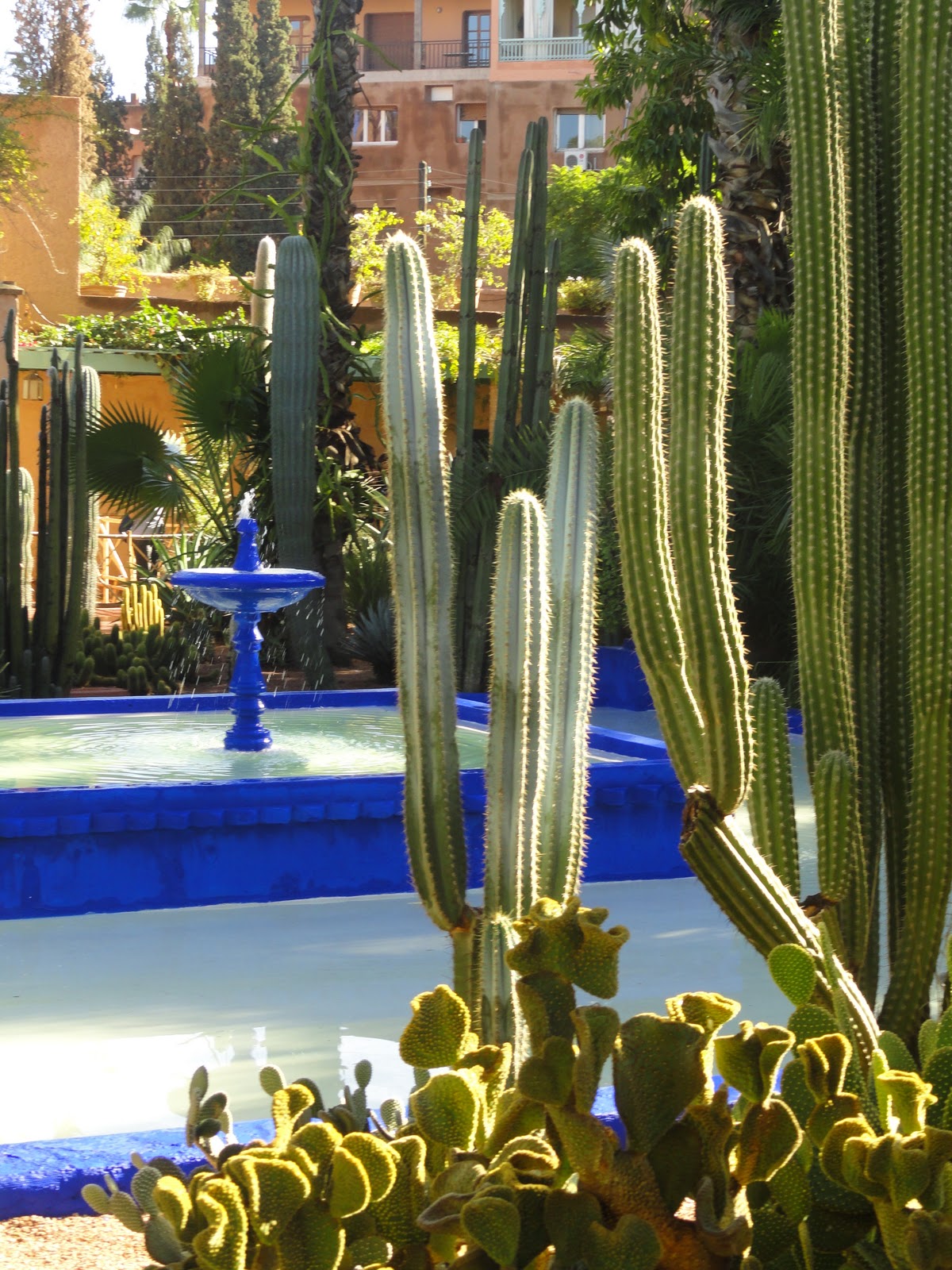
Nora's sister came to spend her Thanksgiving break in Rabat a few days after Eid (the family eventually got over the initial confusion over why she couldn't change her travel plans to get there for Eid).  We went to Marrakech on Wednesday, so she could fly out on Saturday and we could stay on with our school, which had planned our final group trip to Marrakech that weekend.  We had a nice Thanksgiving dinner at "Al Fazia", a fancy guide-book recommended restaurant in the new city in Marrakech.  It was no turkey, but was delicious nonetheless.  Marrakech may have been my favorite city (not place) to visit. It is currently the biggest tourist city in Morocco, but without the haggling, hassling mean people of the Fes medina.  The Djemaa al Fnaa, the main square, is protected as a UNESCO World Heritage Site, and you can find monkey-tamers and snake-charmers and vendors, dried fruit stalls and cafés, fancy horse and buggy cart rides, and the entrances to the souks right off the square.  At night, white tented, lighted numbered restaurant stalls appear, and walking through you hear their owners yelling in any language you can imagine trying to get you to eat at their place.  There are also Berber whiskey vendors, who served the best spice tea in hot little glass glasses, and offered spice cakes which looked like turd cakes and tasted similar.  We walked through the medina many times, through an olive tree farm on the site of an old pool/courtyard, and through the Yvès St. Laurent memorial and garden, full of exotic plants and bamboo and everything brightly painted in blue, yellow, and orange.

Djema al Fnaa at night, Marrakech

Yvès St. Laurent gardens, Marrakech

In between finals and final papers and never-ending Arabic homework and French reading, Christmas was coming... Nora and I played Christmas music in our house and watched the occaisional Christmas movie, but were surprised to see signs of Christmas around Rabat besides in our room.  Some store windows on our way to school in Agdal had displays, of trees or ornaments, and once we heard Christmas music at Al Houda, our new favorite café on the tramway.  Our sister had just gotten her license and wanted to practice driving with us, "the sisters", so we made a deal with her-- we would drive with her if she drove us to Marjane.  Marjane is like the Wal-Mart of Morocco.  There's even a Pizza Hut inside!  We had heard a rumor that they sold fake Christmas trees, and sure enough as soon as you walk inside it was all right there in the first isle.  We bought a tree, fake snow, and some ornaments and red lights.  I remember coming home and setting it up in our room, all the family members would walk inside to check on the progress, and said none of their students had ever done this before.  We thought we were going to keep our wonderful bright little tree to ourselves, but Nora's birthday was a few days later, and the tree was taken into the living room as a party decoration... and we never got it back.  I was glad the family liked it-- I guess it's pretty self-explanitory, but there was never any real discussion about the tree, they just knew we were really happy about it.  For Nora's birthday party, our friends on the program and our across the hall neighbors and even some extended family members came over to celebrate.  Our mom made two tarts from scratch, and bought a cake, and had tons of soda and had made chocolate-covered popcorn, and Nora and I wore djellebas (Nora wore the sparkly bedazzled purple one) even though I thought I was all set with my party sweater (dark green almost-v-neck-- craaaazy I know).  We sang Happy Birthday in all 3 languages, and danced constantly.  They really know how to do birthday parties over there.  One night that weekend we went to a hotel's restaurant/bar/lounge to hear live music, which was fantastic-- the band played old American tunes like Billy Joel, and our waiter promised he was a "champion dancer" back in the 70s.

3id milayd sayeed, Nora!  

The last full week of school, nothing too special... I believe around this time we started playing a lot of Rummy, and then taught ourselves Gin Rummy and my mental math skills returned.  We had heard that Ifrane, a small Swiss-style town inland, usually has snow in the winter, so we wanted to try our luck and check it out as our last trip before we left the country.  Nora and I went with two of our friends and our brother and two of his friends.  It was another instance of travelling with Moroccan men, like the "wedding" trip, where they're an asset because they know what they're doing, as they do live there and are the ones who have the capacity to get things done, but they're a pain because no matter what the male-female ratio is, the males always seem to trump.  We had a good time and walked around Ifrane a bit (after we finally got there, due to an over-endulging sandwich hunt, grocery shopping/delivering, and hanout (corner-store) hopping, even though I was pretty sure they all sold the same things; all this before we even got out of l'Océan, our neighborhood; we were slowed again by a road block, and had to double back and around before reaching Ifrane 5 hours later).  Our first stop was to find a place to stay.  Again, we were with the guys who knew how to get a good place cheap, and who could-- that's key-- so we ended up, essentially, renting a house in the ghetto of Ifrane.  Sure, it was Swiss-style... chwyiiia.  Dirt cheap, though, which was what we were looking for.  But they guys knew the people they were renting from from before, and were Moroccan, and were men, and we didn't make an appearance when they were negotiating the house, so it all happened fine.  The next day, we left the house and walked around a beautiful park with waterfalls and rivers and we rode horses, before driving to Azrou to see monkeys.  Really!  Not in a park, closed-in area, we had to walk through a forest where everyone just knows the monkeys live.  We fed them Family Cookies, these awful wafers we had eaten in Casa, and they walked right up to us.  Then we started the drive home, and after one ridiculous but unavoidable (because of the men-in-charge thing) rest stop, finally made it.

Ifrane

The adventures were ending-- the last week we had our last few classes, then a day off and an AMIDEAST dinner at a fancy restaurant buried in the medina with all the students and professors.  We went visiting the extended families for the last time, saw all the cousins and babies, and had our last few, delicious meals with our family.  There were tears, bazaaaf.  A cab came to get Nora at 1am, and another came to get me at 7am.  More tears, until I passed out halfway to Casa.  I did notice something about the drive though, with the sun rising and warming the cool-ish coastal air-- the fields which had been so dry and barren on that first cab drive from the Casablanca airport to Rabat were a lush green now.  The rainy season is starting, which is how winter presents itself here for the most part.

View from my apartment window-- oh tramway, how I'll miss you.

I don't know how to end this...  corny "this was the best time of my life" or "this has changed me forever" or "well, so that's Morocco!"... I am going back.  I loved it.  I met amazing people and learned about a country and a culture that is in my opinion stuck, one word stuck, between traditions that have so much to do with a religion but also so much more, and between the modern world and developing.  Morocco is Europe Middle East Africa... it is everything, so it is nothing?  There were times when I felt a sense of identity crisis and frustration that just led to a complacency with the status quo, a dejection or disillusionment with the idea of change that is just plain alien to me as an American of today.  I learned more about myself, and came to appreciate so much more my American-ness and what that allows me to do.  But I realized better things here too, a style of life that is slower, where people enjoy things, enjoy simple comforts I know this sounds cliché.  They will sit and enjoy a coffee with someone until far past their next engagement which wasn't exactly pinned down anyways, hence Africa time and I'm pretty sure Morocco must have it's own version of that.  Things are hard but people are happy.  Family is important, so important.  Religion is important-- I am going to miss the call to prayer-- and dignity is important.  It's a work in progress, but it is progressing and there are signs of that.


Basalaama al maghreb, ana tawa7chtek wa lakin inchallah radi kanmeshi fik outani.  :)

(Goodbye Morocco, I miss you but inchallah I will go to you again)

Monday, January 10, 2011

trip to Chefchaouen, Ceuta, Tangier

I started this post before I stopped blogging-- sorry about that, by the way-- and will publish it as it was left.  Captions recently added. 

Spice apothecary, Chefchaouen

Chefchaouen at dusk

Waxy candle-lit dinner in the medina

Blue

Blue

On top of a mountain...

Path towards the Pont de Dieu, Akshor

Hiking in the rain

Dye bazaaaf, Chefchaouen medina

HAT MAN

Tangier, Spain in the background

Cave of Hercules, Tangier

Thursday, October 28, 2010

our trip to Senegal.

Fall Break, 2010.  Original plan:  visit Kate and Liz, my friends from GWU studying abroad in Senegal with Nora.  See some of “real Africa”, some tourist sites in Dakar, and the old colonial city of St Louis as per the recommendation of a friend, and eat some Senegalese “Yassa” with their host families.  New plan, after missing our connecting flight to Dakar in the gigantic Madrid airport and realizing that buying another ticket to Senegal would literally cost an arm and a leg:  Rome.
We arrived in Rome around 10am and got into a taxi outside of the airport, showed the driver a piece of paper with the name of the hotel Nora’s friends were staying at, and watched fascinated as we drove through Italy.   We waited for the friends at a café near the hotel, bought a simple breakfast of a cappuccino and a delicious croissant—essentially a glazed donut in Italy— and tried to absorb where we were.  Women walked by proudly dressed to the nines in heels and fashionable fall clothes, stopping to chat with other women and men in gregarious Italian, as the traffic passed.  No garbage on the streets, no rubble from never-ending construction of a questionably useful Tramway… we definitely weren’t in Rabat anymore. 
Mika needed to do work for a project at the Vatican, so we tagged along.  We wandered through that quarter of Rome, had our first divine taste of pasta at a cheap café, and stayed at the Vatican after Mika was finished with her research.  Theme of the trip:  “we found ourselves at/in…” .  We went inside St. Peter’s Basilica, then meandered over to the Castle di St Angelo, walking up to the top and looking out over the area around the Vatican.  I was astounded by the sheer beauty of the city and the landscape, one and the same, ancient and modern, modern built on top of ancient and people milling about it all. 
Fresh off the plane, touring the Vatican.

View of Rome from the top of the Castle St Angelo

One thing about Italy that we weren’t prepared for was the price of everything… cabs, coffee, everything was much more expensive than in Morocco, let alone than what they would have cost in Senegal.  As a direct result of this, we mastered the bus and metro system quickly when we couldn’t walk anymore, which made travelling around Rome not only cheaper but much more interesting.  Most of what we saw, we stumbled across while walking towards another destination.  On our way back from the Castle, for example, we walked through the Piazza Navona, a plaza with an elaborate fountain in the middle located in between alleys of apartments and boutiques.  It is reminiscent of the Montmartre area of Paris or an artsy district of Boston, or the Eastern Market of DC, with artists sitting behind their paintings and photos, people sitting under umbrellas at outdoor cafes, and mimes, musicians, and other street performers doing their thing.  It was more refreshing than I can say, to be around all this art and open human creativity. 
Art in Piazza Navona.

We stayed in Nora’s friends’ hotel the first night, so we went back there in time to tag along with them on their “free Tuesday night dinner”—they all told us that, even though we came during midterms week, we “planned” to come on the perfect night.  Of course we did!  Delicious lasagna, fresh fresh salad, and some sort of tart dessert… yes, please.  We slept in the next morning, feeling refreshed after our last night of “sleeping” in the Madrid airport.  Then we walked a few minutes and found ourselves at the Colosso and Colosseum complex.  It was all so well-preserved, considering, and walking through you could just imagine people living here thousands of years ago.  We tagged along on part of a tour, heard about the Vestal Virgins, then stood in line to get inside the Colosseum.  It hit me again, not that it hadn’t already about 10 times that day: we were in Rome. 
The Colosso

The Colosseum

Next stop:  find an internet café, and find a hostel for the next two nights.  We ended up booking one near Termini, the main train station and metro stop in central Rome, and were put up in a clean room with six beds.  We rested for a bit and then went back to the first hotel, to meet up with the friends and go out to the Hard Rock Café for someone’s birthday.  Is it bad that the best part of that night for me were the nachos I had for dinner?  They were unreal… how I miss nachos.  Everyone ordered nachos and/or burgers… a bit of Americana is all you need sometimes while travelling.  Yummmmm!!
Our last full day in Rome, we woke up late again and headed out toward the Vatican again.  We stopped for a breakfast of pastries and coffee at a café across from the Basilica De Santa Maria Maggiore, which we went into the day before, just ‘cause it was there.  Once we got to the Vatican, we climbed up to the top of St Peter’s Basilica, to see out across all of Rome.  We walked up into the dome, and then through a narrow door, up a narrower staircase, which narrowed more and more, the walls at an angle, the windows mere slivers of no-wall, until we reached the very top.  What a view.  See below. 
Sugar overload for breakfast in front of the Santa Maria Basilica.

Inside the dome of St. Peter's Basilica.

Smallest staircase ever up to the top of the Basilica...

View from the top, overlooking the Vatican.
After the treacherous descent from the top of the Basilica, we rushed to the Sistine Chapel before it closed to tourists.  It was packed with people, and a guard kept shushing everyone and trying to stop people from taking pictures.  It was—is—absolutely mind-blowing to think that one man painted this entire thing by himself.  And the way it is painted is entirely three-dimensional, so when you’re inside you think you’re in a vaulted chapel, but think about it—it’s just one plain room.  I think the best part of it was the blue.  People are painted all over the walls and ceilings, over a base of blue blue sky.  It was beautiful. 
After the Vatican, we wanted to walk by the Pantheon on our way back to the hostel.  We found ourselves in the Piazza Navona again, and then walked through an alleyway to be met by a sample of ruins, and the Pantheon and piazza around it emerged.  The sheer size of the Pantheon was overwhelming.  In the surrounding piazza, a band just so happened to be playing, so we sat and listened for a while.  Why people don’t set up outside of the medina in Rabat and play, I don’t know… It’s something I hadn’t even realized I’d been missing, reminded me of New York and DC.  We consulted the map (again), and realized how close we were to the Trevi fountain.  Thinking we’d see it the next day, we kept walking, and then literally ran into the street it was on.  It is the hugest (?), most elaborately carved fountain I’ve ever seen, with waterfalls basically flowing from statues, all built into a building.  We each sat on the ledge of the fountain and tossed a coin over our left shoulder with our right hand, and made a wish.  We met up with Nora’s friends later for a last dinner of delicious crepes: prosciutto, fresh mozzarella, and spinach.  YUM.
Musicians at the Pantheon.

Trevi fountain.
Our last day in Rome:  A last leisurely morning at the hostel, then we wandered around by the Spanish Steps to find a café for breakfast.   As we walked down a narrow street lined with high-end stores, we heard music and found a woman sitting in between a café and a flower shop playing the cello.  Of course, we ate breakfast at that café, and then continued wandering.  We walked to the Ministry of Culture and Heritage, a formidable white building with two gigantic iron flying horses on top that we had seen from wherever else we were in the city.  After finally figuring out what it was, we walked back past an archaeological site of an old fish market/village to the hostel, and then to the train station.  After getting to the airport and waiting 6 hours for our delayed flight, we finally made it to our hostel in Spain.  We met our two other friends in the same hostel at breakfast, who had spent their weeks off in Spain, and then left for home—Rabat.  Hamdullah!
Home sweet home :-)

Saturday, October 23, 2010

Meknes and Fez

Two weekends ago, our entire program went on our first trip together to the imperial cities of Meknès and Fez.  Fez is the oldest city in Morocco, and was the first capital when the country as we know it today was first established in the 8th century.  We took a bus to Meknès, which was the capital of Morocco in the 17th century under Moulay Ismail.  First stop was the old Stables of Moulay Ismail, and then to the prison where we descended into a stark, dark basement holding room where holes in the ceiling let in light and also, in the old days, food lowered down from the ground above.  From there we walked around the medina and into the Musée des Arts et Métiers Traditionels de Meknès, a traditional art museum converted from one of the king’s riyads in the past.  Some rooms were preserved as originally furnished—unbelievably ornate—while in other rooms where rugs, pottery, and woodwork in the traditional Meknèsi style the floors, walls, columns, and even ceilings were tiled (zellij) and embellished.  After lunch of couscous and juice—any kind or combination of fresh pressed juice you can imagine—we continued on our way to Fez.  At one point we stopped on a mountain road to look down into the white-washed city of Moulay Idriss, named after the 8th century king of Morocco and off-limits to non-Muslims.  Inside the city is a mosque of the same name, which is a point of pilgrimage for Muslims.  It was a spectacular view, nestled into the mountains and looking like a white oasis in the rugged landscape. 

Outside one of the doors to the medina in Meknes.

A traditional riyad room maintained in the Musee.

Our next stop was Volubilis-- called Walili in Arabic, which is equally as fun to say-- an archaeological site of Roman ruins (and now a UNESCO World Heritage site).  Structures like Roman baths were still intact, as were some of the elaborate tiling on the floors depicting various scenes and characters.  From the top, you can see little towns tucked away into the mountains, and again the vast, dry openness of the landscape. 
The center of Volubilis.

On a mountain overlooking the city of Moulay Idriss.

From Volubilis we continued on to Fez, checked into our hotel and proceeded to explore the medina, which is the largest and oldest medina in all of Morocco.  We wandered through the labyrinth, passing stalls and stalls of fresh meat—I mean fresh as in skinned animals displayed everywhere— and then herbs, and then the jewelry/clothes/general artisan products sections.  It was like a much, much larger version of the Rabat medina that I’m familiar with, “a medina’s a medina” as someone said.  The most obvious distinction, aside from the sheer size and crowdedness of the thing, was the behavior of the people working there.  The Fez medina is a major tourist attraction, and as a result walking through the medina for us means getting hassled and accosted and pushed to buy things and pay for services.  If you stop walking, it’s all over.  We soon realized that, and found refuge in a little ice cream parlor, named “Disney Channel”, of all things, tucked into one of the alleys. 
The lobby inside our hotel in Fez.

The next day we went on an actual guided tour of the medina, with a professor from Al Akhawayn University in Ifrane.  First stop was at Madrassa Bou Inania, built in the 14th century as a religious school and mosque.  In addition to all the tiling that I pretty much expect to see everywhere by this point, even on ruins, the walls were all constructed of wood and stone elaborately carved in Arabic and Maghrebi script.  We walked through the “dormitory” area, which consisted of very small stark rooms, meant to encourage a life without distraction for the importance of the studies.  We left the madrassa and meandered through to the Nejarine Museum, dedicated to historical regional woodcrafts and located in the metalwork section of the enormous medina.  After the tour, we found some more souk sandwiches, which are enough to fill you up for an entire day and cost approximately $2 American, and then started off on our own tour of the medina to find the famed tanneries. 
Center of Madrassa Bou Inania.

Maghrebi script and zellij on the walls of the Madrassa.

The metalwork area in the Fez medina.

Outside the Nejarine Museum in the middle of the medina.

We were told that the tanneries were located far in the middle of the medina and that our best bet would be to pay someone to take us there, but we decided to try to find them ourselves.  We walked back to the metalwork district (amazingly we remembered how to find our way through the twisting, cramped alleys), where we began to be accosted by young boys asking, “You want to see the tanneries?  This way, this way!” each pointing in a different direction.  We finally escaped from one boy who had been following us through the alleys, only to be taken to the tanneries by his friend—when we got there, we spotted the first boy hiding behind a wall watching us.  He was with another boy, all about 12 years old, who earlier in the day had shouted insults and obscenities at us in Arabic (which we understood, thanks to our Moroccan friends).  Eventually, we got to the roof of a leather goods store which looked down over the tanneries—huge stone baths filled with different substances for cleaning, treating, and coloring the freshly skinned leather.  Our little guide explained what each substance was for; there was one area, the little boy explained to us, where the baths were filled with the technically-named “pigeon shit”, to thoroughly clean the leather.  We were shown to a “pharmacy” of pungent herbs and spices afterwards, to replace the tannery odors.  The owner of course tried to entice us to purchase something, of course, after giving us a lengthy explanation of each herb and their properties.  That was the Fez medina—everyone trying to get money from tourists, by any means possible, and turning any would-be stroll into a blindered brisk walk.  The shopkeepers get frustrated: we were walking out of the medina after seeing the tanneries and a man was offering us the menu to his restaurant, so we said “leh, shokran” (“no thank you”), as we always do.  We passed him, and then heard “leh shokran, I HATE LEH SHOKRAN!”  Oy vey.  Sorry, mister, but I hate “You want to eat here?  Good price, 70 dirhams…”  C’est la vie.

Overlooking the dying baths in the tanneries.
The rest of Fez:  MacDo (with elaborately carved ceilings) for dinner on a rainy night; one of the king’s many palaces (one in all of the major cities and regions of Morocco); and a synagogue in the area just outside of the palace where the Jewish population traditionally was located.  One last tour through the medina for traditional Faissi soup at a hole in the wall soup stand (literally, a hole in the wall), 5 d’s for a bowl of hot buttery, garlic bean soup with a hunk of bread.  Also a stop outside of the Karouine university and mosque, located inside the medina as well, which was founded in the mid-9th century, and is still operating today as an academic and religious education center.  It was eye-opening to see the dynamics of this city, so old and yet modern in parts, the people so tough and jaded, making a day of exploring a run to preserve your sanity.  As with every trip I’ve been on so far, it’s made me look at Rabat in a new light.  I’m spending this weekend not travelling, and I’m realizing again how nice it is to be able to walk down familiar streets, seeing the same shopkeepers, going to the café where the owner knows us and will talk to us about where we’ve been in Morocco or how we find the Arabic language.  Rabat is such a balanced city, small for a capital city in my opinion and kind of sleepy, especially when compared to bustling, high-rise Casa.  But it’s a place where I can carry out my life, not the same as home in America of course, but in a way that makes sense here. 

Fez at night: fountain and MacDo

Palace at Fez

Faissi soup in the medina
Looking into Karaouine.